
HPE ARUBA WIRELESS SOLUTION
HPE Aruba outdoor campus Wi-Fi for yards, walkways and loading areas
Prepared by Xunhui Information · English publication: 2026-11-12
Plan outdoor access around work routes, obstructions, mounting and backhaul. Verify antenna, power and environmental requirements with installation and application acceptance tests.

This reference design is a starting point for project discovery, not a completed customer case. Final quantities and settings require site measurements, endpoint compatibility checks and a release-specific implementation design.
1. Requirements analysis
| Requirement | Discovery and design input |
|---|---|
| Coverage and purpose | Define plaza, road, entrance and loading clients and heights; separate Wi-Fi access from long-distance backhaul. |
| Site and mounting | Survey buildings, seasonal foliage, poles, wind load, weather, lightning protection and grounding. |
| Transport and power | Confirm fiber/copper paths, length, PoE and weather protection; evaluate backhaul separately where wired access is unavailable. |
| Regulatory and maintenance | Verify destination bands, versions, antennas, permits and elevated maintenance access. |
Workload and capacity example
Illustrative zone: a plaza and two loading entrances with 150 phones and 20 operational clients at peak. Model gathering locations, client uplink and actual applications, and test indoor/outdoor transitions. Survey placement, antenna angles and power paths; a maximum advertised range is not usable business coverage.
Deliverables at this stage: a measured floor plan, client/application inventory, current topology and dependencies, agreed test objectives and constraints. Keep associated-client counts, active-client counts and concurrent application demand as separate inputs.
2. Solution design
Outdoor clients → appropriately rated Aruba outdoor APs → protected wired or fiber backhaul → campus services. Assess wired backhaul first; any mesh design requires its own support and capacity review.
Survey the operating area
Map walkways, vehicle routes, loading work and actual client heights, including trees, metal structures and moving obstructions. Measure interference and candidate antenna directions. Derive coverage boundaries from required work locations rather than a nominal advertised radius.
Review installation and backhaul
Evaluate candidates such as AP-565 or AP-675 against regional, environmental, power and mounting requirements. Qualified installers must follow the selected model guide for grounding, surge protection, sealing and cable restraint. Check power reach and switch environment; assess fiber and local power where the copper design is unsuitable.
Treat mesh as a separate design
Verify model, software, regional and backhaul-band support before considering mesh. Measure the target workload over the intended hop count and failure path. Deliver a location plan, antenna directions, port records and installation acceptance evidence, with obstruction and seasonal retest requirements.
3. Network topology and forwarding
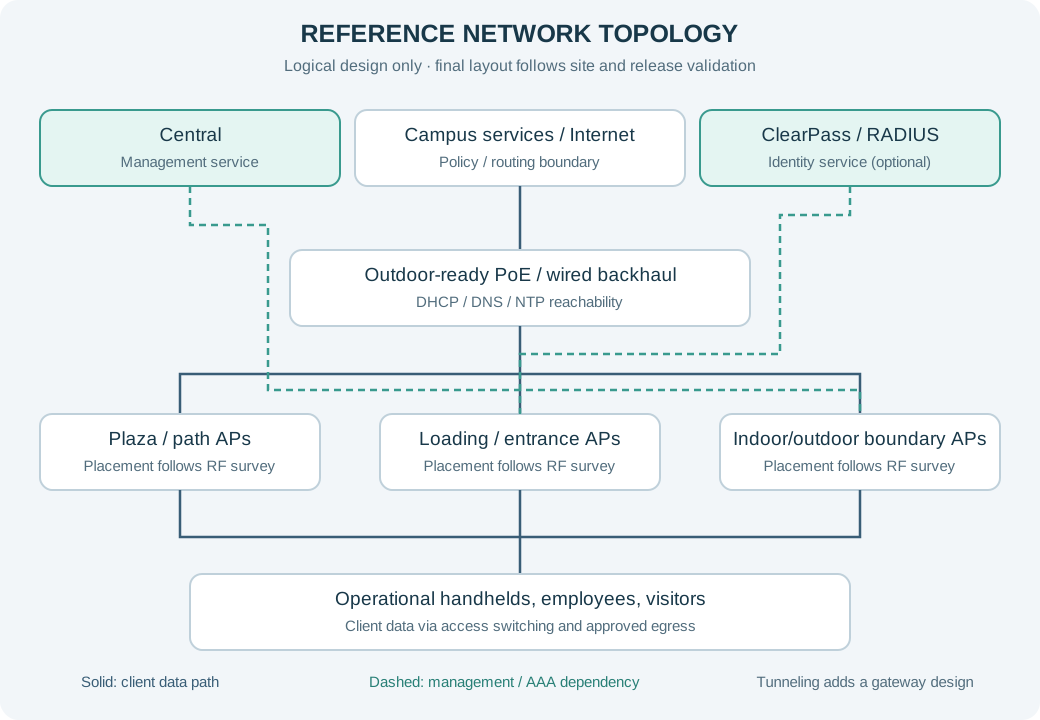
Prefer reliable wired backhaul and separate outdoor guest and operational policies. A mesh alternative needs its own line-of-sight, airtime, hop, channel, failure and capacity assessment. Lightning protection and grounding require qualified installation following the device guide and local requirements.
Dashed paths denote logical management or authentication dependencies, not physical direct cables. Central is the management service, not the client data-plane transit point. If tunneling is chosen, redraw and validate the AP-to-gateway path and the authenticator location for that mode.
SSID, segment and access-policy example
| Segment / example VLAN | Access policy |
|---|---|
| OPERATIONS / VLAN 710 | Allow loading/campus operational clients to approved applications only. |
| STAFF / VLAN 720 | Preserve identity policy across indoor/outdoor movement and test address/session boundaries. |
| GUEST / VLAN 730 | Restrict public-area guests to approved Internet egress. |
| MGMT / VLAN 799 | Control outdoor management and retain pole/cable mappings. |
Names and VLAN IDs above are illustrative and must be mapped to the customer address plan. A VLAN is not a complete security boundary: enforce the approved ACL/firewall/role policy at the selected forwarding points and verify both allow and deny behavior. Publish only the minimum necessary SSIDs and verify legacy-client exceptions separately.
4. Implementation plan
- Site walk:Confirm service boundaries, poles, obstacles, foliage, grounding and backhaul resources.
- Placement trial:Test bidirectional client use at proposed height/orientation and indoor/outdoor transitions.
- Engineering design:Document mounts, transport, PoE, sealing, grounding and safe access against installation guidance.
- Configuration and transport:Verify destination channels/power, roles, management and uplink headroom; test mesh separately if selected.
- Peak/environment validation:Test gathering peaks, loading operations and entrances; retain weather, client and location data.
- Handover and inspection:Deliver placement, orientation, grounding and rollback records and post-weather/foliage inspection rules.
Change control and rollback gate
Before each batch, name the change owner, business approver and recovery operator. Preserve the approved pre-change configuration and verify that the hardware/software supports the intended recovery. Stop or roll back if critical transactions fail, identity rules are wrong or agreed recovery limits are exceeded. Capture timestamps and logs before altering the next variable.
5. Configuration and procurement checklist
| Candidate / component | Items to confirm |
|---|---|
| AP-565 | Regional SKU, current availability, supported software, power, included components and lifecycle. |
| AP-675 | Regional SKU, current availability, supported software, power, included components and lifecycle. |
| Management and access | Management version, device tier, term, account ownership, AAA capacity and required service integrations. |
| Installation and services | Mounts, antennas, power supplies, optics, cabling, survey, commissioning, training and agreed support scope. |
6. Acceptance and operational handover
- Test work-height clients along walkways and loading points, recording obstructions and application success.
- Inspect mounting, grounding, sealing, power and uplinks with installation evidence.
- For mesh, measure workload and failure behavior over the planned hop count.
- Exercise a power or uplink alarm and confirm safe maintenance access.
Agree numeric coverage, SNR, packet-loss, latency and recovery thresholds with the application owner before the pilot. Record locations, representative clients, load and software so results can be reproduced.
7. Prepare a project request
Send scaled plans, device and application schedules, current software and topology, power and cabling records, destination and rollout constraints. We use these inputs to discuss a project-specific configuration and quotation.
8. Regional and architecture checks
Product families above are candidates for evaluation. Confirm exact destination SKUs, certifications, permitted channels and software support before ordering. For mainland China, global 6 GHz capability does not establish local permission to enable it. AOS 8, AOS 10 and Central features require version-specific verification.
Apply the guidance to your project
Share the model, quantity, destination and existing network so we can discuss the complete configuration.
Discuss configuration & quotation ↗