
HPE ARUBA WIRELESS SOLUTION
HPE Aruba healthcare Wi-Fi for clinical mobility and device access control
Prepared by Xunhui Information · English publication: 2026-11-12
Design clinical wireless coverage, identity policy and recovery around mobile workflows and medical-device capabilities, with separate patient and visitor access.
This reference design is a starting point for project discovery, not a completed customer case. Final quantities and settings require site measurements, endpoint compatibility checks and a release-specific implementation design.
1. Requirements analysis
| Requirement | Discovery and design input |
|---|---|
| Clinical scope | Separate mobile nursing, rounds, barcode workflows, office and patient access; agree what the WLAN may carry. |
| Device constraints | Obtain vendor requirements for radio, encryption, roaming and support; do not change medical-device settings without approval. |
| Routes and materials | Map wards, stations, lift lobbies, shielded rooms and cleaning restrictions; test at working height. |
| Continuity and audit | Agree clinical windows, change approval, traceability, least privilege and clinical fallback workflows. |
Workload and capacity example
Illustrative pilot inventory: 24 nursing handhelds, 12 rounds devices and 30 approved specialist endpoints. Measure transaction frequency, timeouts and mobility tolerance by workflow, then add office/patient peaks. These 66 endpoints are a planning example, not medical-device compatibility evidence or a clinical availability commitment.
Deliverables at this stage: a measured floor plan, client/application inventory, current topology and dependencies, agreed test objectives and constraints. Keep associated-client counts, active-client counts and concurrent application demand as separate inputs.
2. Solution design
Clinical and medical devices → Aruba wireless access → PoE switching and service segmentation → clinical applications. ClearPass/RADIUS provides access policy; gateways follow forwarding and enforcement requirements.
Start with clinical device constraints
Inventory carts, handhelds, clinical computers and medical devices separately. Record supported bands, authentication, application timeouts and manufacturer restrictions. Survey wards, treatment areas, corridors and storage areas. Obtain the relevant clinical and equipment approvals before changing device connection profiles.
Make policy auditable
Evaluate certificate-based enterprise access for capable devices. Restrict approved exceptions to the services they need; a MAC address alone does not prove device identity. Create a device-to-application policy matrix and verify its enforcement. Keep patient and visitor access isolated from clinical systems.
Test mobility and dependencies
Walk real care routes while observing representative application sessions. Review RADIUS, DHCP, DNS, time services and gateways as separate dependencies. Agree outage tolerance and change windows, then test recovery in a controlled pilot. Deliver device exceptions, policy ownership and test evidence. A wireless deployment does not itself certify overall healthcare compliance.
3. Network topology and forwarding
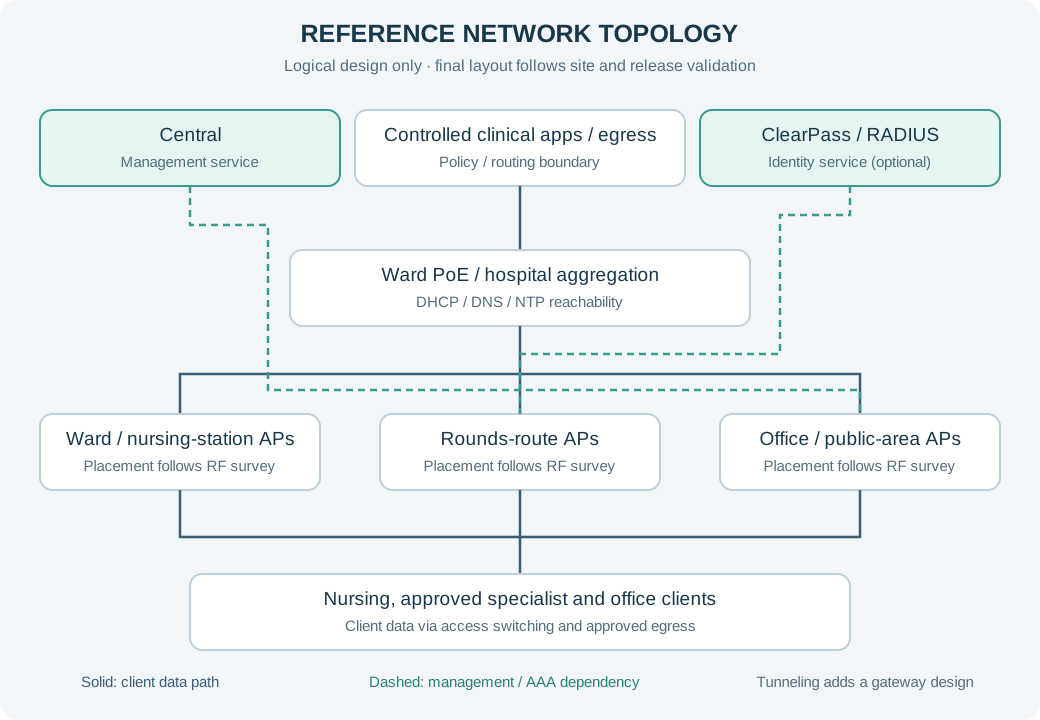
Clinical endpoints enter controlled services; staff office and patient access have separate policies. Specialist exceptions require least privilege, registration and review. Document identity, logs and application dependencies. Resilience must cover authentication, uplinks, power and egress; overlapping AP coverage alone is not end-to-end redundancy.
Dashed paths denote logical management or authentication dependencies, not physical direct cables. Central is the management service, not the client data-plane transit point. If tunneling is chosen, redraw and validate the AP-to-gateway path and the authenticator location for that mode.
SSID, segment and access-policy example
| Segment / example VLAN | Access policy |
|---|---|
| CLINICAL / VLAN 510 | Approved nursing/rounds endpoints with access only to designated clinical and infrastructure services. |
| MED-DEVICE / VLAN 520 | Vendor-validated device exceptions tied to assets and minimum required access. |
| STAFF / VLAN 530 | Independent staff office identity and policies. |
| PATIENT / VLAN 540 | Patient/guest access restricted from clinical services with defined expiry and support. |
Names and VLAN IDs above are illustrative and must be mapped to the customer address plan. A VLAN is not a complete security boundary: enforce the approved ACL/firewall/role policy at the selected forwarding points and verify both allow and deny behavior. Publish only the minimum necessary SSIDs and verify legacy-client exceptions separately.
4. Implementation plan
- Joint scope review:Agree scope, inventory, approvals and test windows with IT, clinical representatives and device owners.
- Route and RF validation:Survey rounds/nursing routes, fire doors and shielded areas; do not introduce failure tests during care without approval.
- Policy preparation:Verify authentication, trust, RADIUS, DHCP and logs; document exception assets, permissions and review dates.
- Nonclinical validation:Use approved simulation/test environments for mobile requests, policy denials, recovery and vendor constraints.
- Limited ward pilot:Cut over an approved representative zone with workflow owners monitoring failures and rollback criteria.
- Acceptance and operations:Deliver ward policies, logs, dependency drawings and recovery plans; revalidate after relevant device software changes.
Change control and rollback gate
Before each batch, name the change owner, business approver and recovery operator. Preserve the approved pre-change configuration and verify that the hardware/software supports the intended recovery. Stop or roll back if critical transactions fail, identity rules are wrong or agreed recovery limits are exceeded. Capture timestamps and logs before altering the next variable.
5. Configuration and procurement checklist
| Candidate / component | Items to confirm |
|---|---|
| AP-615 | Regional SKU, current availability, supported software, power, included components and lifecycle. |
| AP-635 | Regional SKU, current availability, supported software, power, included components and lifecycle. |
| CX 6300M | Regional SKU, current availability, supported software, power, included components and lifecycle. |
| Management and access | Management version, device tier, term, account ownership, AAA capacity and required service integrations. |
| Installation and services | Mounts, antennas, power supplies, optics, cabling, survey, commissioning, training and agreed support scope. |
6. Acceptance and operational handover
- Repeat representative clinical transactions on approved devices along the care route.
- Verify permitted medical-device services and denial of patient access to clinical systems.
- Test an approved dependency failure and record application impact and recovery.
- Exercise exception approval, emergency access, device isolation and audit retention workflows.
Agree numeric coverage, SNR, packet-loss, latency and recovery thresholds with the application owner before the pilot. Record locations, representative clients, load and software so results can be reproduced.
7. Prepare a project request
Send scaled plans, device and application schedules, current software and topology, power and cabling records, destination and rollout constraints. We use these inputs to discuss a project-specific configuration and quotation.
8. Regional and architecture checks
Product families above are candidates for evaluation. Confirm exact destination SKUs, certifications, permitted channels and software support before ordering. For mainland China, global 6 GHz capability does not establish local permission to enable it. AOS 8, AOS 10 and Central features require version-specific verification.
Apply the guidance to your project
Share the model, quantity, destination and existing network so we can discuss the complete configuration.
Discuss configuration & quotation ↗